
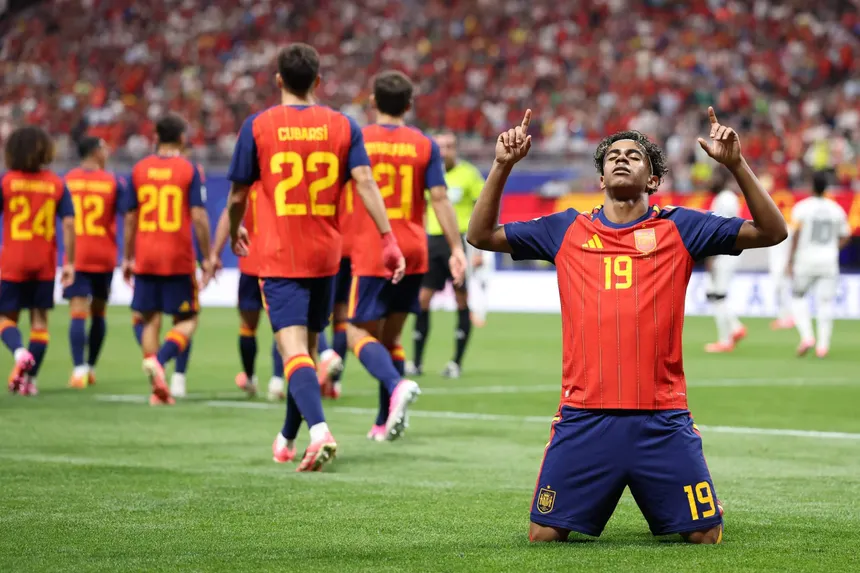

Spain’s national team is in the middle of one of the most enviable talent surges in European football. While most nations cycle through generations with gaps and rebuilding phases, Spain currently has a pipeline that overlaps: seasoned winners from the recent European Championship run alongside teenage prospects already starting for elite clubs. Put together on paper, Spain’s likely starting XI a few years from now reads less like a projection and more like a murderers’ row.
In goal, Spain has options developing behind the current national team choice, but it is outfield where the depth becomes startling. At centre-back, Pau Cubarsí has already established himself as a first-team fixture at Barcelona while still a teenager, pairing positional maturity with the ball-playing instincts modern systems demand. Alongside him, Spain can call on established internationals to bridge experience and youth.
In midfield, Spain’s identity has always been control, and the next generation doubles down on it. Rodri anchors as one of the most complete deep-lying midfielders in the world, dictating tempo and screening the back line. Ahead of him, a cluster of technically gifted playmakers gives the coaching staff multiple ways to break down a low block — quick combination play through the middle or width supplied by wingers who can beat a full-back one-on-one.
That width is where Spain’s future may be most frightening for opponents. A crop of young wide players has emerged from La Liga academies with the kind of dribbling instinct and end product that used to be rare in Spanish football, historically more associated with intricate short passing than individual explosiveness. Pairing that dribbling threat with Spain’s traditional passing rhythm creates a hybrid style — patient in possession, but suddenly vertical when a gap appears.
Up front, Spain has the luxury of choosing between a mobile false nine who drops to combine, or a more traditional focal point who can finish the chances that a possession-dominant team inevitably creates. Either profile fits inside the same passing structure without disrupting it.
What makes this generation genuinely daunting for rivals is the compressed timeline: several of these players will overlap in their prime years simultaneously, rather than the gradual handover most nations experience. If health and club form cooperate, Spain’s starting XI in the next major tournaments could combine the control of their tiki-taka era with a directness and physicality that era sometimes lacked — a version of La Roja built to win in more than one style.