

Introduction
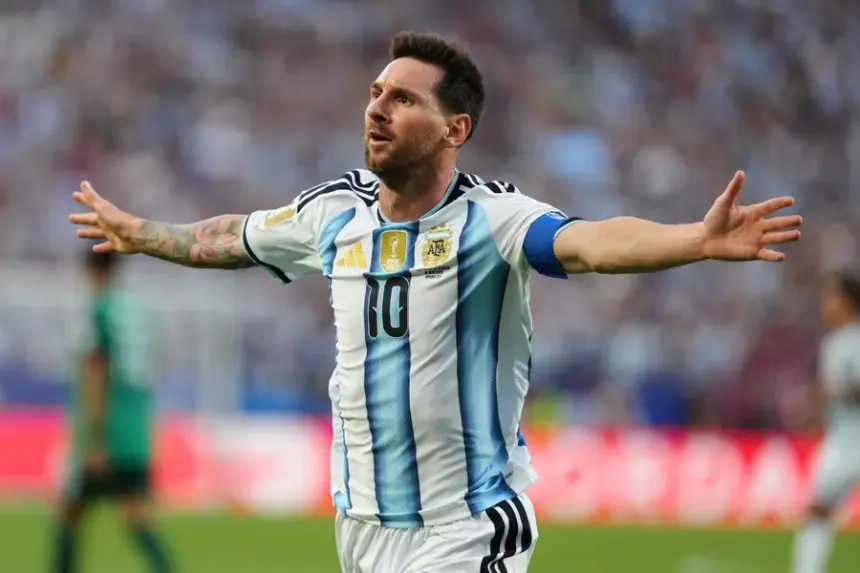
Rosario is a river city, not a football factory in the way Buenos Aires is often described, yet it produced the player who now stands alone at the top of the World Cup’s all-time scoring list. Most supporters can recite the trophies. Fewer know about the growth hormone treatment paid for partly by Barcelona, the goalkeeper he almost became, or the fact that his own country briefly turned its back on him. Twenty years after his World Cup debut as a teenage substitute against Serbia and Montenegro, Messi is currently playing in his sixth tournament — and rewriting the record books again in the process. These ten facts sit outside the usual highlight package.
Table of Contents
- The medical condition that nearly ended his career before it began
- Why Argentina almost lost him to Spain
- The five-goal night that broke a national record
- He wasn’t always a No. 10
- The Barcelona release clause that became a global talking point
- A brief international retirement that lasted less than two months
- His World Cup goal record, updated in real time
- The stat that makes his 2026 campaign statistically unusual
- Family, foundation and life away from the pitch
- What comes after this World Cup
1. A childhood growth hormone deficiency shaped his early career
At age 11, Messi was diagnosed with a growth hormone deficiency. His family’s health insurance in Argentina could not fully cover the cost of treatment, which ran into hundreds of dollars a month. River Plate showed interest but reportedly balked at funding it. Barcelona’s youth setup, after a trial, agreed to pay for the treatment as part of the deal that brought him to La Masia at 13 — a decision that shaped both a boy’s body and the trajectory of world football.
2. He could have played for Spain instead of Argentina
Because Messi moved to Barcelona as a young teenager and held Spanish residency, he was eligible to represent Spain at various youth levels. Spanish football federation officials made contact during his development, but Messi chose to stay loyal to Argentina, making his senior international debut in a friendly against Hungary in August 2005.
3. He once scored five goals in a single international match
In a June 2022 friendly against Estonia, Messi scored five goals in one game for the first time in his Argentina career — a rare full match haul even by his standards, and a reminder that his scoring output isn’t confined to World Cup summers.
4. He was tried out as a left-back, not a forward, in his earliest youth football
Long before he was Argentina’s all-time top scorer, a young Messi was deployed in defensive positions by his first coaches at Grandoli, the boys’ club his father helped run in Rosario. His technical gifts were obvious even then, but it took a couple of seasons before youth coaches settled on using him higher up the pitch.
5. His Barcelona contract contained a release clause larger than most club budgets
During his final years in Catalonia, Messi’s release clause was reported at figures exceeding €700 million — a number designed purely to be prohibitive rather than realistic, reflecting how far outside normal transfer economics his value had drifted.
6. He briefly retired from international duty in 2016
After Argentina lost the 2016 Copa América Centenario final to Chile on penalties — the team’s third final defeat in three years — an emotional Messi announced he was quitting the national team. The retirement lasted less than two months before he reversed the decision and returned to the fold, a U-turn that arguably set up everything that followed: the 2021 Copa América title, the 2022 World Cup, and his continued presence at the 2026 tournament.
7. He is now, outright, the all-time leading scorer in men’s World Cup history
For years Messi shared space near the top of the all-time list with Germany’s Miroslav Klose. That changed for good during the 2026 tournament. Messi became the outright top goalscorer in men’s World Cup history during the group stage, surpassing Klose’s mark of 16 with a brace against Austria. He didn’t stop there — Messi’s tally reached 20 World Cup goals during the 2026 tournament, a record set by overtaking Klose’s previous mark of 16. He is doing this in a record sixth World Cup appearance, played alongside fellow six-time participant Cristiano Ronaldo.
8. His 2026 World Cup numbers are historically strange
Statistically, Messi’s 2026 group stage was one of the odder efficiency stories in tournament history: among 618 outfield players with at least 90 minutes, he ranked first in goals scored while ranking last of all 618 in distance covered per 90 minutes. It reflects a deliberate Argentina game plan — midfielders such as Rodrigo De Paul, Enzo Fernández and Alexis Mac Allister handle pressing and defensive work so that Lautaro Martínez can create space and Messi can conserve his energy for the moments that matter. He has also become the first player to score in eight consecutive World Cup appearances, extending a streak that stretches back to 2022.
9. Family and philanthropy shape his life away from football
Messi is married to Antonela Roccuzzo, a childhood friend from Rosario, and the couple have three sons. His charitable foundation, established in 2007, has funded pediatric healthcare and education programs, much of it channeled back into Rosario and broader Argentina. Unlike some of his commercial peers, Messi has kept a comparatively low public profile off the pitch, rarely courting the kind of tabloid attention that follows other global superstars.
10. This World Cup may be his international farewell
At 38 during the 2026 tournament, Messi has given no formal confirmation of retirement, but the run in North America is widely regarded inside Argentine football circles as his last realistic World Cup appearance. Whatever happens in the knockout rounds, his all-time scoring record now stands as one of the most secure marks in the sport, with only Kylian Mbappé — his closest active challenger — within realistic touching distance over the coming years.
Key Statistics Table
| Category | Figure |
|---|---|
| World Cup goals (all-time record) | 20 |
| World Cups played | 6 (2006–2026) |
| Career international goals (Argentina) | 124 |
| World Cup titles won | 1 (2022) |
| World Cup Golden Balls | 2 (2014, 2022) |
| Ballon d’Or awards | 8 |
Historical Context
Messi’s rise mirrors a broader shift in Argentine football’s production line — from the physically dominant archetypes of the 1980s and ’90s to a generation of technically schooled attackers developed partly in Europe. His path also parallels, and eventually surpassed, that of Diego Maradona, the only other Argentine footballer to reach comparable cultural status, whose own World Cup triumph in 1986 hung over Argentine football for 36 years until Messi finally matched it in Qatar.
Expert Analysis
Coaches who worked with Messi at youth level consistently point to two traits: his ball control in tight spaces developed almost by necessity due to his smaller stature as a child, and a footballing intelligence that allowed him to conserve energy even before sports science made “load management” a common term. His current World Cup form — high output, low physical exertion — is arguably the most refined version of a game he has been quietly building since his Grandoli days.
FAQs
How many World Cups has Messi played in? Six — 2006, 2010, 2014, 2018, 2022 and 2026 — a joint record with Cristiano Ronaldo.
Did Messi ever consider playing for a country other than Argentina? He was eligible for Spain through residency but always intended to represent Argentina, debuting for the senior side in 2005.
What is Messi’s World Cup goal record? He holds the all-time men’s record with 20 goals, having overtaken Miroslav Klose’s mark of 16 during the 2026 tournament.
Conclusion
The broad strokes of Messi’s career are public property by now — eight Ballon d’Ors, a World Cup in Qatar, a scoring record built goal by goal across two decades. It’s the smaller details — the release clause economics, the retirement that didn’t stick, the five-goal night against Estonia — that round out the picture of how an undersized kid from Rosario became the most statistically decorated player in World Cup history.